Production Process
Since its foundation, Vista Alegre has been a benchmark for sophistication and quality, standing out for the creation and production of pieces that are true expressions of Portuguese tradition, while embracing innovation through contemporary and timeless design.
Porcelain
Shaping of the Pieces
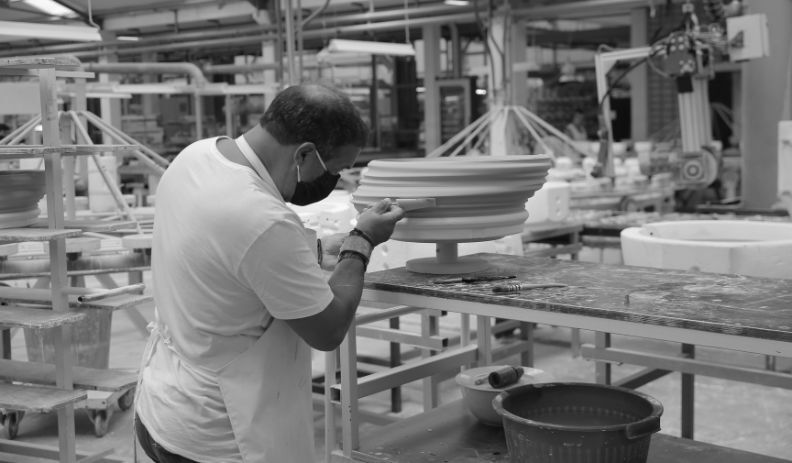
In the pottery section, which is dedicated to the production of hollow pieces such as coffee pots and teapots, slip casting is used. In this technique, liquid porcelain paste, also known as slip, is poured into plaster moulds. The formation of the piece depends on the plaster’s absorption capacity and the time the paste remains inside the mould. Once the desired thickness of the layer has been reached, the moulds are emptied and the excess paste is removed. After a period of drying, the piece is finally removed from the mould.
The production of flat pieces, cups, and pieces with an axis of symmetry is carried out using the jiggering process. The plastic porcelain paste, also known as “cigars”, is placed on a plaster mould and compressed by a rotating metal head which presses the paste against the mould, forcing it to take its shape.
Firing
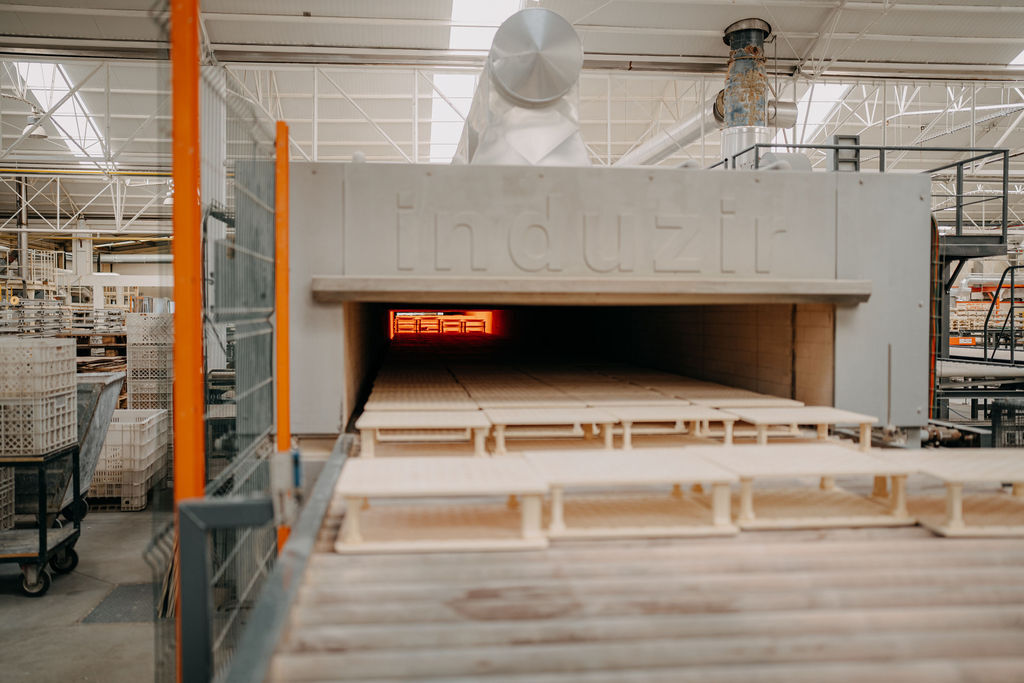
Once dried and finished, the pieces undergo the first firing, known as bisque firing, at approximately 980 °C. They are then coated with a transparent glaze, which gives them a smooth, glossy surface. This is followed by a second firing at around 1400 °C, which is essential for the porcelain to acquire its characteristic translucency and vitrification.
Throughout the entire process, strict quality control is carried out, with all white-fired products being manually inspected.
Porcelain Decoration
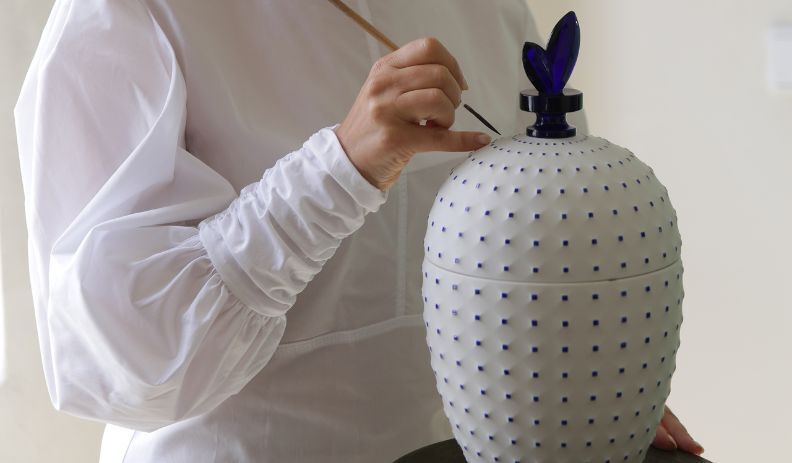
The main porcelain decoration techniques include decals, lining, hand painting, and spray painting.
Decal decoration consists of applying motifs previously printed on special paper to fired pieces. The motifs are transferred onto the piece after being immersed in water.
Spray painting, carried out using an airbrush, is mainly used to apply backgrounds and requires precision in the preparation and application of colours.
Hand painting, maintaining the tradition of the Vista Alegre School of Painting, is reserved for pieces of high artistic and commercial value. This technique requires skilled workers and in-depth knowledge of colours and their behaviour during firing.
Material
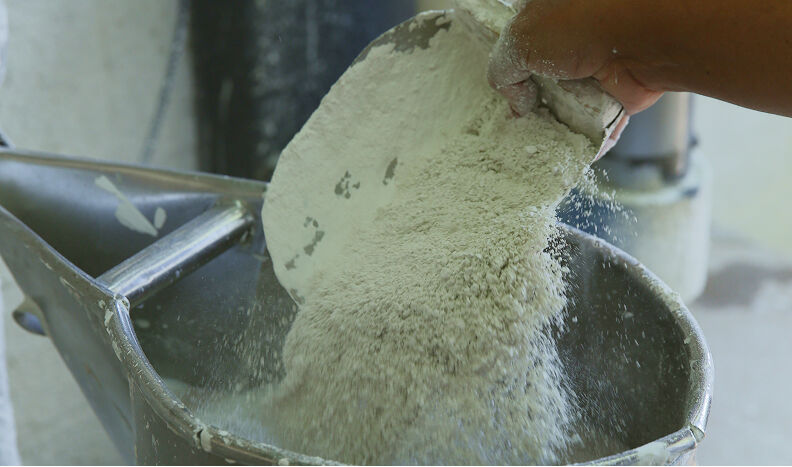
Porcelain paste is composed of varying proportions of kaolin, quartz, and feldspar.
Kaolin, a pure and highly refractory clay, gives the paste its translucency and whiteness. Feldspar acts as a flux during firing, while quartz is essential for forming the structural framework of the pieces.
Different production processes are used depending on the type of porcelain product and its characteristics.
Crystal
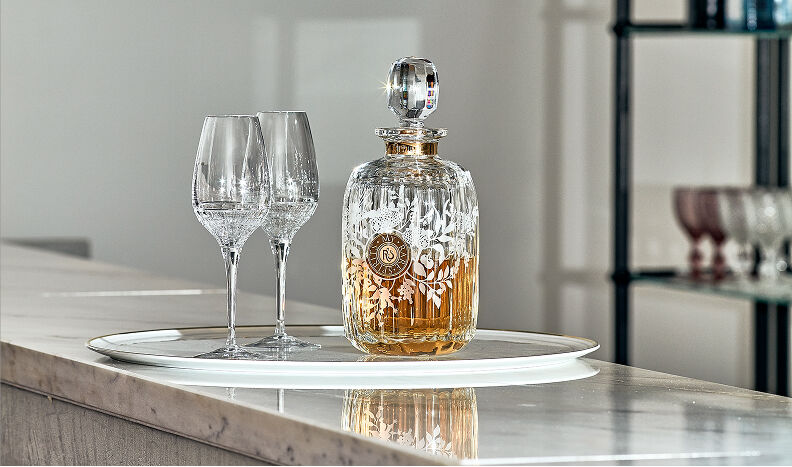
The production of Atlantis crystal begins with high-purity raw materials. Sand, potash, and litharge are the main components of the mixture, giving the crystal its distinctive characteristics: purity, transparency, density, and exceptional brilliance.
These high-quality raw materials are combined with one of the most advanced crystal-melting techniques: electric melting in a continuous furnace. This process transforms the glass mixture into one of the purest crystals in the world: Atlantis crystal.
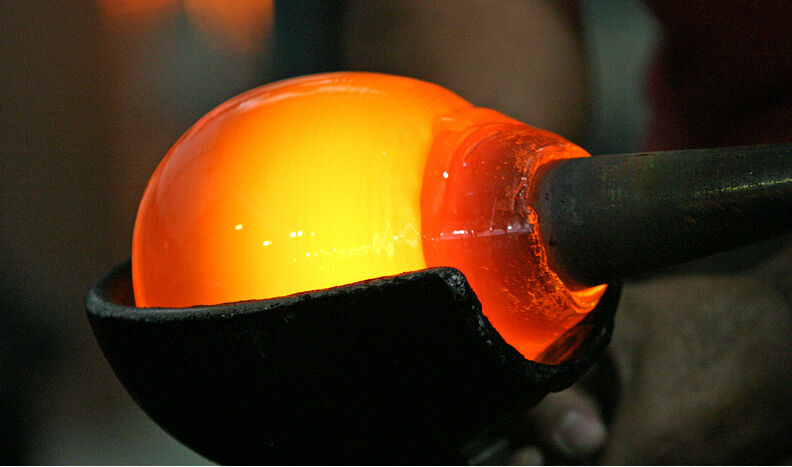
Moulding
The knowledge accumulated over generations by master glassmakers, organized into working teams, gives shape to the molten glass. Working at temperatures close to 1100 °C and using wooden, aluminium, or steel tools and moulds, they create a wide variety of products, including glasses, bottles, jugs, salad bowls, centrepieces, and many others. Their experience and expertise determine the thickness of each piece, which varies according to the force of the breath used to shape the glass.
The resonance, brilliance, transparency, luminosity, and greater weight are some of the distinctive characteristics of Atlantis crystal.